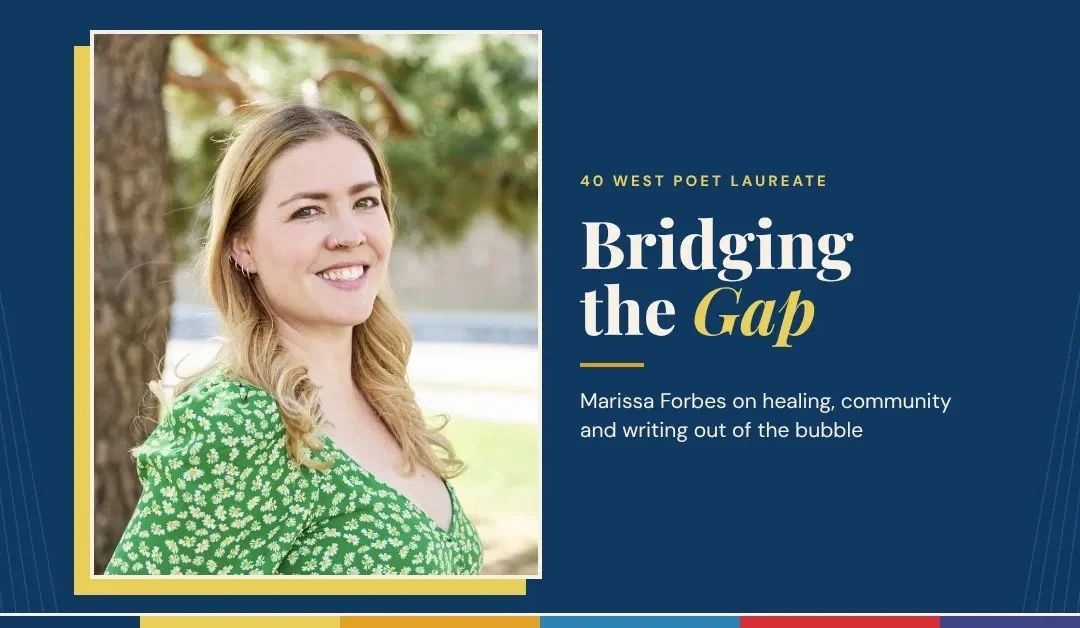
Poetry has a reputation as a solitary art: one person, one page, one quiet room. Marissa Forbes has spent the last several years proving otherwise.
She has written her way through grief and reinvention, filled three books with poems, and spun their lines into paintings, bookmarks, and jewelry. But the more she made, the clearer it became that the work wanted company.
As poet laureate of West Colfax and 40 West Arts District, she has turned that realization into a mission, pulling poets into galleries, Colorado writers into the same rooms, and anyone with a notebook up to the mic.
One idea runs through it all: art means more when it’s shared.
Losing the Novel, Finding the Poem
Forbes studied creative writing at Pratt Institute in New York City and was part of only the program’s third graduating class.
“Performance, publication, and mass media were what their creative writing program was, ” she explained. “So we really got to dip our feet into anything and everything, from critique to capsule writing, play, poetry, short fiction, long-form fiction.”
She chose fiction and began a novel. Then, during her junior year, everything changed.
“I had my computer stolen my junior year after I had already written half of my novel. It was a really hard process. I was able to get through it, but it sort of turned me off from fiction for a long time. But sometimes when a tragedy happens, it’s really leading you to something better.”
She turned to poetry, and to off-Broadway plays built from poems she called “philosophical comedies.” Then an unexpected pregnancy took her from New York City to Cape Cod. “Cape Cod is beautiful, but terrible for creatives,” she said, laughing, “because if you don’t do seascapes and you don’t write about whales, you’re kind of not really seen as an artist.”
Writing With Veils
For years, motherhood came first, and writing went quiet. What brought her back was loss. After her biological father died in 2020, her therapist advised her to start writing again.
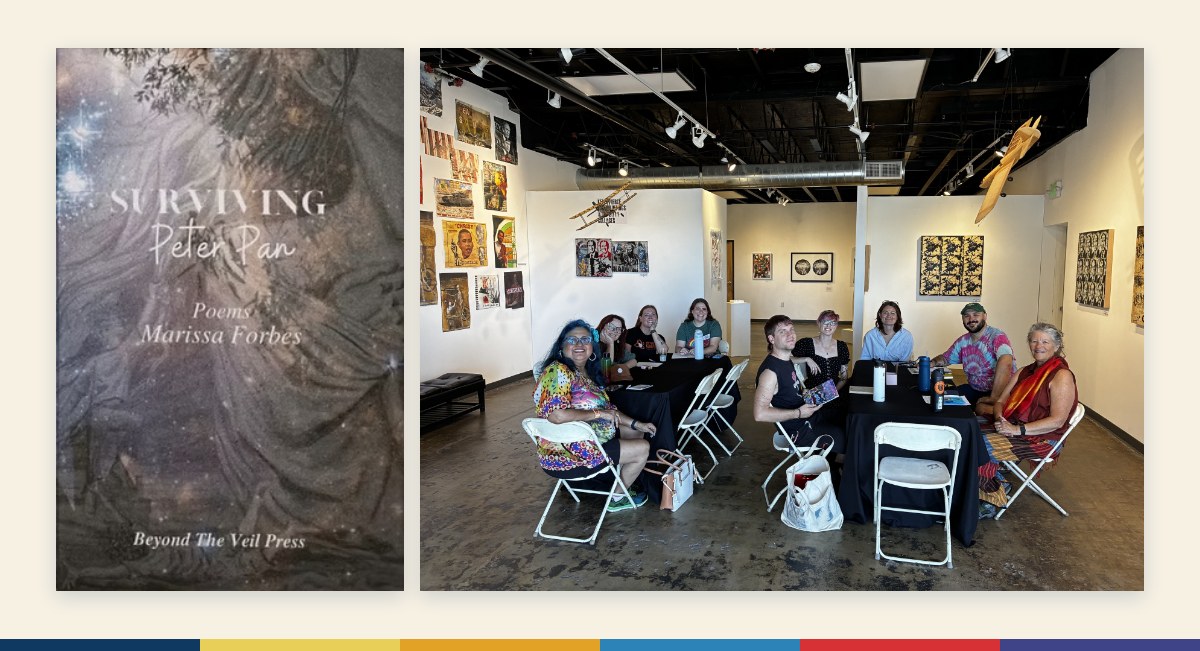
“I went to poetry for instant gratification. I wrote with veils, in a way. I wasn’t fully ready to talk about my experiences yet, but I could write metaphorically about them.” Shortly after, she left an abusive marriage. That experience became Surviving Peter Pan, a collection of poems told from the perspective of Neverland’s inhabitants and built on J.M. Barrie’s original story. The book later won the Winter 2023 chapbook contest hosted by Beyond The Veil Press, a queer-and disabled-owned independent publisher centered on mental health and radical healing.
It started, of all places, at bedtime.
“I loved Mary Martin’s Peter Pan play. I thought I could read it to my kids,” she remembered thinking. “And I got one chapter in out loud, and I was like,‘ Peter Pan is terrible. I can’t read this to my kids!’”
Forbes came to see Peter as a narcissist, and recognized her own experiences with harmful people. Peter Pan’s story gave her a way to write about her past relationships without naming them outright.
That veil gave her a way in. “It was reading the book and literally taking moments and transcribing them and expanding them into this collection,” she said. But she quickly learned she couldn’t heal alone.
“I really just found that writing in a bubble was hard,” she said. In 2021, she found community with Twenty Bellows, a Colorado literary press where she became managing editor, and began using poetry “as healing for myself and for others.”
An Obsessive Process
Forbes doesn’t write one poem at a time and stitch a book together later. “I like to thematically create something,” she said. She finds an obsession and goes all in.
For example, Emily Warren Roebling, the de facto chief engineer of the Brooklyn Bridge, was the subject of her first collection, Bridging the Gap: Poems & Ethos for Emily Warren Roebling, which meant reading everything she could find, often in the margins of other people’s stories. “More often than not, she’s just a paragraph in an engineering book or a STEM book,” Forbes said. “There’s so much about this person that needs to be known.”
She wrote that collection during a 10-month course with Community Literature Initiative, a Los Angeles poetry program built on a simple rule: read every day, write every day. She later served as a teaching assistant there and taught for two years. Meanwhile, the poems she wrote between projects became a third book, Brief & Bleeding Margins, published by World Stage Press.
“Brief is ironic, because the titles are excessively long. I think I just immerse myself excessively.”
After three books, she was spent, but not done making things. “I need to be creative. I need to be producing something.” So she started painting. Her collage paintings, along with custom bookmarks and jewelry, carry lines from her own poems. “I start with a poem and an idea,” she said. “I’m like, oh, I want to do a painting that has this line in it, and then I jump from there.
”She teaches other writers to do the same. “If you want to do bookmarks, make 20 of your own,” she said. “It’s about getting people attached to your work in unique ways.”
Becoming the Bridge
Forbes found 40 West Arts through visual art. In 2024, she set a goal of getting a painting on a gallery wall every month, and the district helped her hit it. Around the same time, the call for Colorado Poet Laureate came out.
“I was like, I’m not qualified for that yet, but maybe in three years when the next call comes out, I can utilize this time to keep growing and learning and building,” she admitted. But when 40 West reopened its own laureate call, she saw her chance. “What a great way to test out my abilities.”
She describes the role simply: “to spread awareness and build creativity within that district.”
Her vision for it was shaped partly by contrast. Working with the Los Angeles poetry scene, she saw a culture where writers sometimes held opportunities close. “It felt very competitive, to the point where people wouldn’t share opportunities with each other. I kind of noticed the ways I didn’t want to build there.”
Instead, she helped knit together poets in Denver, Boulder, Aurora, and Colorado Springs, encouraging writers in each city to show up for the others. When a literary press they all admired opened submissions, the group kept checking in. “Did you get it in? Did you get it in? Let’s go. Let’s do this together,” she recalled. “Somebody’s gonna get published. We’re so excited. It’s just about lifting each other up.”
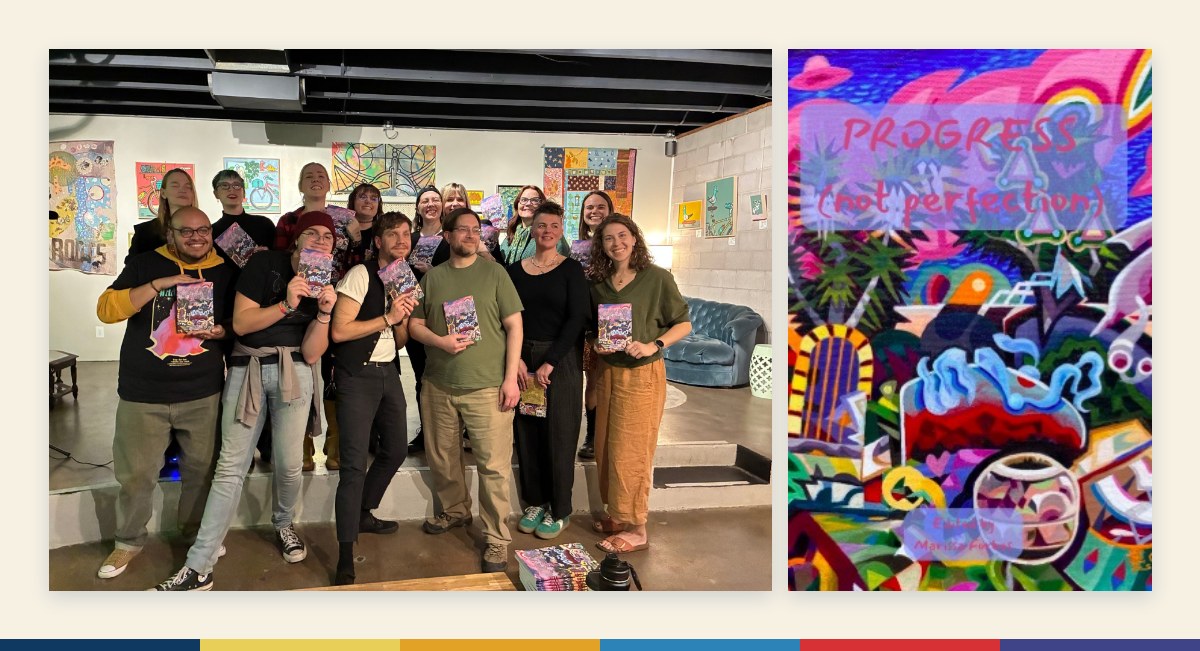
Her laureate capstone, the art and poetry anthology PROGRESS (not perfection), grew from the district’s own season of change, as construction moves through the West Colfax corridor. It also gave her a roster of poets ready to teach and perform.
“The creation of 40 West Arts District was always meant to be a celebration of culture, but additionally it’s a deliberate strategy for economic revitalization and community building,” said 40 West Arts Board Chair Bill Marino, “Marissa Forbes acts as the living embodiment of that strategy. Throughout her two years as Poet Laureate, she has broken down barriers to the arts, sparked more creativity and joy, and fostered more human connections within our community. We fully intend to find ways to continue our relationship with Marissa when her tenure ends in December.”
Writing the District
40 West Arts shows up in her work and in the work she inspires. At the end of September, Forbes led a visual writers’ retreat designed to bring writers into 40 West’s galleries, the 40 West ArtLine, and Aviation Park.
Participants added photos and poems to the fence near the Arc on the ArtLine along Pierce Street.
Writers decorated rocks and returned them to the park, and made small fidget books inspired by the sculptures and the theme of flight. At Edge Gallery, they wrote in response to a political installation and heard a talk on reclaiming propaganda through writing.
At Core Art Space, a facilitator used color psychology: participants built word banks from the art, traded them, and wrote from someone else’s list. At the HUB, they wrote five-senses poems about place, tasting salt, running feathers across their skin, and learning the building once housed a chicken-fried restaurant.
“There are so many ways to use visual art to create writing,” Forbes said,“and that is spreading.” So are open mics in galleries, something she pushed for last year to give writers spaces beyond breweries, coffee shops, and libraries.
Authentically “Not” Perfect
On artificial intelligence, Forbes sees a surprising upside. “It is a beautiful opportunity for us to come together more, to create in person with each other more,” she said. She is a self-described lover of the em dash and the Oxford comma, both now flagged as supposed tells of machine writing. “Don’t take those away from me,” she said.
“But the fact that those have become markers, I’m like, okay. So then, how can I step this up? How can I make my work more unique?”
Across her circle, Forbes explained that writers are answering with new forms, dropping capitalization and punctuation on purpose, and writing poems in response to each other’s work. She has long given her students the same freedom, with one condition.
“Grammar needs to be consistent within that poem. If you choose to have no periods, then have no periods across the whole poem. The reader shouldn’t have to guess why you’re making the grammar choices you’re making.”
The result, she said, is writing that is weirder, bolder, and more human. “That’s the best thing about AI; it’s pushing authenticity farther.”
Advice for Emerging Writers
Forbes’s first piece of advice is the one that changed her own path. “I wholeheartedly believe in going to open mics,” she said. “That’s where you find your voice. That’s where you find people that are going to support and uplift you. There are so many people that I only see at open mics, but I know so much about them, and I love them dearly.
”Fiction writers, she said, should find each other. “Instead of running it through AI, find a peer editor and trade.”
And above all, “give yourself a chance.” Answer the open calls, research the presses you admire, volunteer. “Ask for things,” she said. “Share what you want to do, and people will reach back out to you.”
Then, she prescribes, read as if your writing depends on it, because it does.“Be obsessed with stuff. Dog-ear books. Write in books all the time,” she said. “If there’s a line you like, go ahead and make that a poem title and write a poem based on it. Just keep reading, and take chances.”
Healing Is Radical
Asked what lasting impression she hopes her work leaves on a reader, Forbes reached for one of her own poem titles.
“Healing is radical, and it is not radical. That’s really what I try to push in everything I write. It really does encompass the underlying reason why I write and why I think it’s important, especially in a time like now,” she said.
“It’s about finding each moment in the day in which you can face. Making your bed is a big task sometimes, and cooking dinner. Be proud of doing those things as well. The little wins matter, too”
For Forbes, bridging the gap has always meant more than connecting artists to their community. It means getting through the hard days until you can look back on them, and carrying a poem out of the bubble and into a room full of people ready to celebrate it. Emily Warren Roebling spent years seeing the Brooklyn Bridge through to the other side. Forbes, two years into her own span on West Colfax, has made it a practice to build the bridge and then make sure the next artist can walk across it, too.
Want to hear Marissa Forbes read, or share a poem of your own? Here is where to find her:
- Monthly open mic: Third Monday of every month, 6 to 8 p.m., at Hooked on Colfax.
- Prompts & Pints open mic: Every other month, second to last Friday, 7-9pm at Fiction Beer Company.
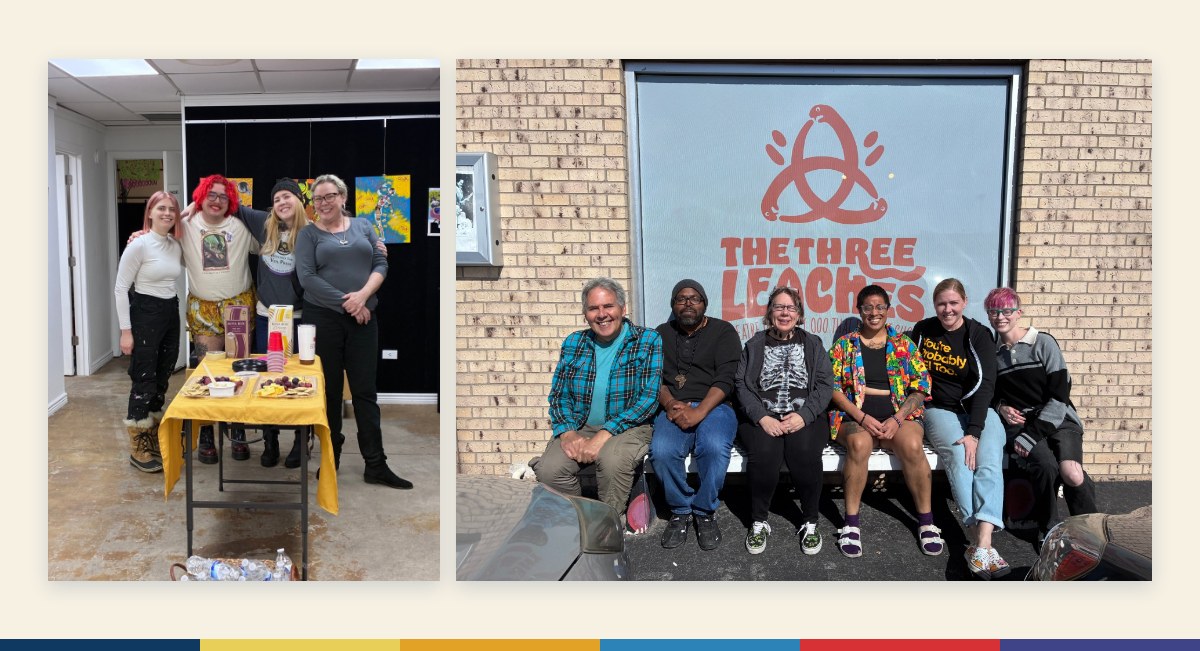
- Poetry-to-play intensive: This January at Three Leaches Theater: Turn a poem into a one act play and get audience feedback at a live stage reading.
- Her books and art: marissaforbes.com and on Instagram at @word_nerd_ris.
And if you have an idea for her next obsession, she is taking suggestions!