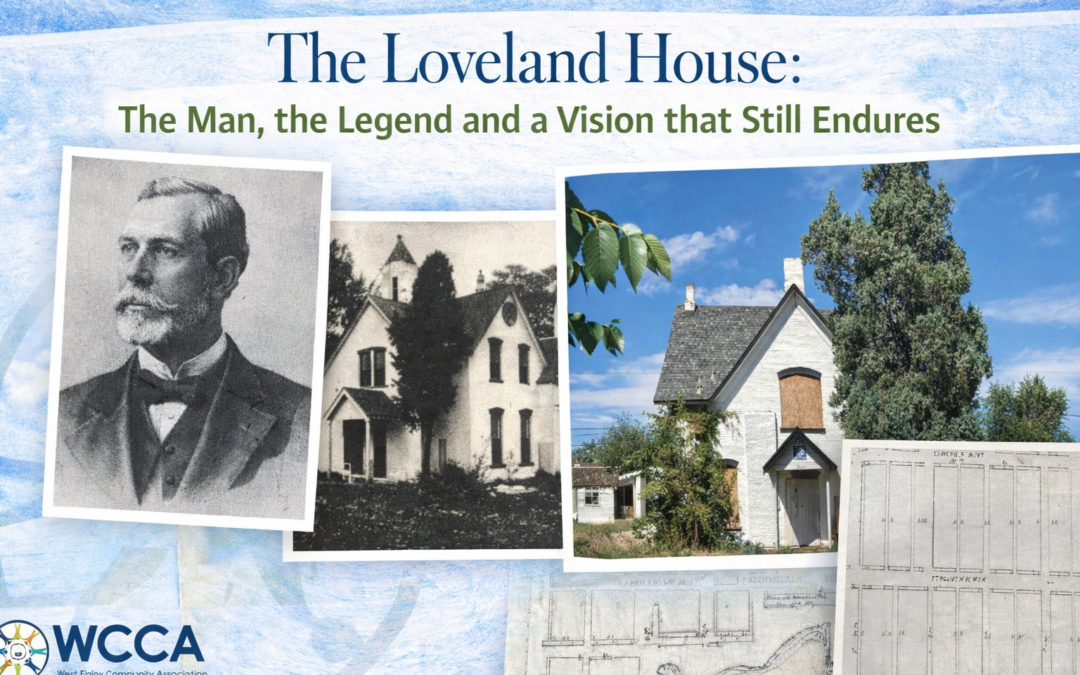
William A. H. Loveland had a vision.
His vision was to bring people together to enjoy the idyllic rolling countryside near the foothills and lounge in its cooler temperatures along West Colfax in what now is Lakewood—a frontier landscape in the late 1880s, decades before Lakewood would incorporate as a city.
Loveland was no stranger to bold ideas. He and his wife Miranda had journeyed westward during the daring days of the Colorado Gold Rush in the late 1850s. In the decades that followed, Loveland’s name became synonymous with innovation and enterprise.
Over the next 35 years, Loveland founded the first railroad in Colorado—the Colorado Central—and later the Denver and Intermountain Railroad that linked Denver to Lakewood and Golden. Never content with complacency, he also engaged in many business ventures, local and state government issues, and even had his name put forward for the presidency at the 1880 Democratic National Convention.
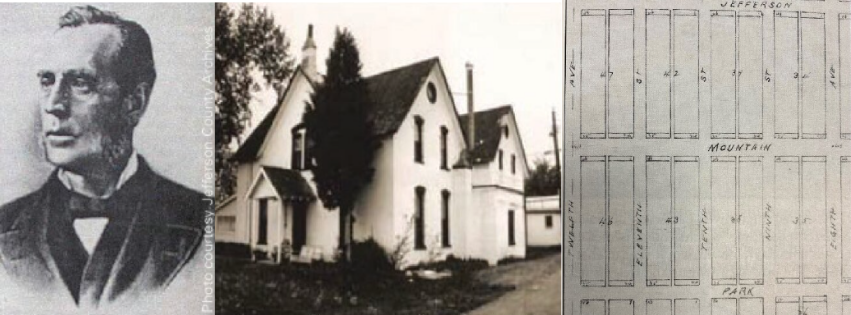
In 1888, the Lovelands and their business partner Charles Welch drew up the original boundaries for a new development in the Two Creeks Neighborhood west of Denver—stretching from West Colfax Avenue up to West 10th Avenue and from Harlan Street to Teller Street.
The area was already changing from primarily farms and orchards to a diverse community of residents, with commercial and industrial businesses. The trip purchased the land for $2.25 per acre and developed the first two plots. A year later, they offered lots of the subdivision to potential buyers, spanning 96 acres and five blocks wide, and named it Lakewood.
In Loveland’s eyes, his latest endeavor was more than “just his next development”—it was the cornerstone for cultivating a thriving, lively community. His vision for Lakewood was one where residents could revel in the tranquility of the “great outdoors” and be awestruck by the area’s natural beauty. Loveland understood that nurturing a bustling and dynamic community would give residents a sense of purpose and belonging, enabling them to connect with their peers and grow their families.
Loveland built his own house to bring his vision to life, serving as the centerpiece of the new development. Located on Harlan Street (at the time it was called Anna Street), Loveland designed the house to be an elegant structure that showcased the surrounding landscape’s beauty.
Fully constructed in 1889, Loveland built the two-and-a-half-story house in the Queen Anne style, popular in the late 19th century. The charming white brick house boasted an asymmetrical façade, steeply pitched roof, stained glass bay windows, and intricate decorative details.
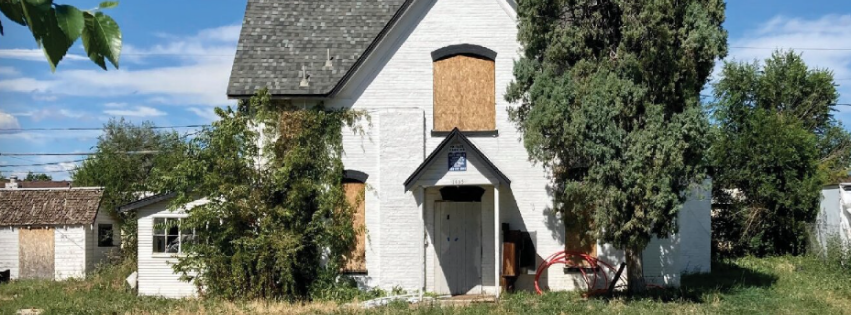
The Loveland House became the talk of the town, playing host to lavish dinner parties, community meetings, charity fundraisers, and political events. The Loveland family knew how to throw a party, and their stunning home was the perfect place to advance their budding community.
In 1890, Loveland designed Lakewood’s expansion to include more than just naming streets. He envisioned a community that provided residents with everything they needed: a school, a church, food services, and parks—all within walking distance. This level of foresight was impressive and ahead of its time, as no one attempted to create such a comprehensive planned subdivision in this area until after World War I. His vision was ambitious, and he worked tirelessly to make it a reality.
However, Loveland never witnessed his dream of a thriving community fully realized. The devastating and sudden decline of the silver market in 1892 sent the region into a deep recession, forcing many businesses and residents to leave in search of better opportunities. Loveland and Welch never built another Loveland-style house, and Loveland never saw the economic recovery. He died two years later in 1894 at the age of 70.
But William Loveland’s vision didn’t die with him. It is still alive today. We can see it throughout West Colfax, as the torch is passed to other visionaries and civic leaders, investing in the future of the area as a destination—just as Loveland did 130+ years ago. Now, in this century, the vision continues to inspire the imaginations of new investors, new residents, and new visitors alike—from the founders of South Park who purchased iconic Casa Bonita, to the energetic leadership of West Colfax-based 40 West Arts (Lakewood’s only state-certified creative district), and from the ever-engaged residents who live in our historic neighborhoods, to Austin-based developer Artesia, working on a new masterplan for the Westland Town Center—and so many others. West Colfax reminds us that a robust and vibrant community can flourish by working together on a shared vision, such as our Vision 2040 Action Plan.
“In many ways—our vision for Lakewood’s West Colfax corridor is the same as Loveland’s: to continue to improve the area and to attract new residents, new businesses, and new investments to its premiere location and all that Lakewood and the corridor have to offer!” says former Mayor Adam Paul.
The history of Lakewood is rich and diverse. Lakewood today reflects the changes and growth over the century-and-a-half. Preserving landmarks like the Loveland House is about recognizing the community’s history and our collective role in shaping its future. The Loveland House serves as a tangible reminder of Lakewood’s evolution and a symbol of Lakewood’s unique character.
Today, the Loveland House has a new buyer who plans to restore its exterior, keep its legacy alive, and align it with the vision for the district. This is exciting news. As Lakewood residents, we have a responsibility to preserve our cultural heritage for future generations. By supporting the restoration and preservation of the Loveland House, we ensure that this landmark will continue to be a touchstone of inspiration for generations to come.